202Distributed Performance Tuning
Author: Dr Heinz M. KabutzDate: 2012-05-28Java Version: 7Sources on GitHubCategory: Concurrency
Abstract: In this newsletter, it is up to you to figure out how we improved the performance of our previous Fibonacci newsletter by 25%.
Welcome to the 202nd issue of The Java(tm) Specialists' Newsletter sent to you en route to Lausanne in Switzerland to visit one of my favourite customers.
javaspecialists.teachable.com: Please visit our new self-study course catalog to see how you can upskill your Java knowledge.
Distributed Performance Tuning
After I sent the last newsletter about the Fibonacci calculation with fork/join, I produced a graph of what the CPU looked like on my 8-core server. The graph is of the user time; the system time is negligible. The y-axis is percentage CPU on my 8-core system. The x-axis is the time. This particular run completed in 31.5 minutes.
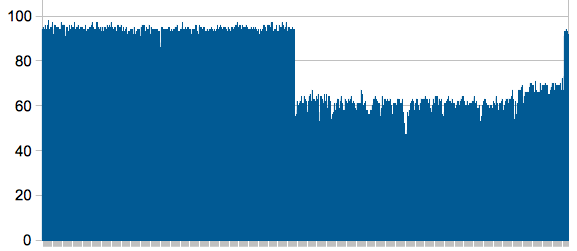
My question to you is: "At the half-way point, the CPUs drops down to an average of about 60% utilization. What can we do to keep the CPUs busy?"
Whilst the system was 60% utilized, I did a stack dump. Click here to download the vmstat output, with the stack dump near the end.
Now it is over to you. You need to come up with an explanation of what is keeping the CPUs from being busy and then give us a solution of how to fix it. Hint: I wrote about this behaviour in one of my newsletters, about 7 months before I moved from South Africa to Greece.
There is one more output that you may request. I won't tell you what it is, but if you ask for it specifically I will send you a link to where you can download it. You need this other piece of the puzzle to come up with a good solution.
I showed this exercise to Kirk's performance tuning class last week and we solved it together in about 10 minutes. This one change got the time down from 31.5 minutes to 23.63, representing a noticeable 25% improvement. That is impressive for a single change!
Kind regards
Heinz
Comments
We are always happy to receive comments from our readers. Feel free to send me a comment via email or discuss the newsletter in our JavaSpecialists Slack Channel (Get an invite here)
Related Articles
Browse the Newsletter Archive
About the Author
Java Champion, author of the Javaspecialists Newsletter, conference speaking regular... About Heinz
Superpack
 Our entire Java Specialists Training in one huge bundle
more...
Our entire Java Specialists Training in one huge bundle
more...
Free Java Book
Java Training
We deliver relevant courses, by top Java developers to produce more resourceful and efficient programmers within their organisations.